 Jani Hovila
Too busy to improve. When working purely with you, my dear marketing leaders, one thing is clear:
There are always more things you could do than you can do. And on top of that, a bunch of sudden changes or fires to put out that are seemingly out of your control.
This article was originally published in our newsletter. Subscribe to the newsletter and get the thought of the week in your email:
I think anyone who has spent any time in a leadership position understands that. But how do you still make the time to do those critical but not urgent things? You know what I'm talking about. Those things you know you should spend more time researching, thinking, and eventually acting upon.
We strongly advocate that as a marketing leader, your one secret to success is to work more “on marketing” than “in marketing”.
We recommend that because if you don’t work on your function's strategic direction, your function's future needs, or stop and assess where your marketing function is headed regarding all the changes, opportunities, and threats (as discussed in Vol 1 this year), there is no one to do that for you. You drift with the tide.
Quite surprisingly, one thing we got praised for last year was an easy tool we shared first with one client battling with time management and constant firefighting. She was pretty new to the “director” level role and was still battling the internal battle of how being a “manager” differs from being the one who is in charge at the end.
She got quite bombarded with all the stakeholder management time that went up exponentially. Trying to still arrange time for the whole marketing team. And putting down fires as they came. And trying to never say no to anyone who needed her.
We shared a very easy time-tracking Excel template with the idea that if you want to change where you spend your time, you first need to know how you spend it now.
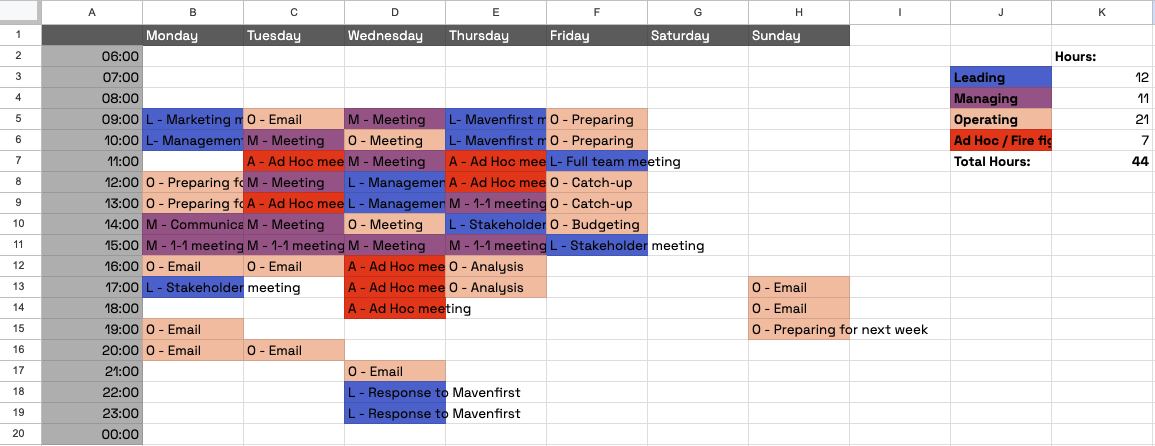
After using the template, she did a couple of major changes:
Stakeholder relationship schedule
Made some sort of meeting rhythm with all the key stakeholders, we provide value as a marketing function. Decided which relationships she owned and which belonged to some of the team members.
Stop weekly 1-to-1 sessions and access for the whole team
She had marketing managers who led their teams. But still, she wanted to have 1-to-1 sessions with each team member. She continued to have 1-to-1 sessions with the managers, who then held their own sessions with their team members. She also limited access based on the topic. If it could be solved without her, she did not participate or delegated that to the managers to handle.
Set up "deep work" time for the strategic thinking
Working “on marketing” was the first to be cut due to ad hoc and firefighting. She scheduled “deep work” time to just work “on marketing” and kept that time as sacred. Hour there and there, one off-site day a month etc.
Based on the feedback and results, we have begun using it more frequently with clients facing similar challenges.
Here are some of the categories we have used with our clients:
- By type of work: Leading, Managing, and Operating
- By stakeholder group: Business stakeholders, marketing management team, my team members, outside partners
- By type of work: Meetings, written work, producing something, traveling, presentation
- By business lines: Common, Business Line A, Business Line B, outside
I highly recommend adding a specific color or category for ad hoc or those things that need your immediate attention, and you didn’t see coming.
Of course, these are just examples. You should pick the dimensions you feel would work best for you.
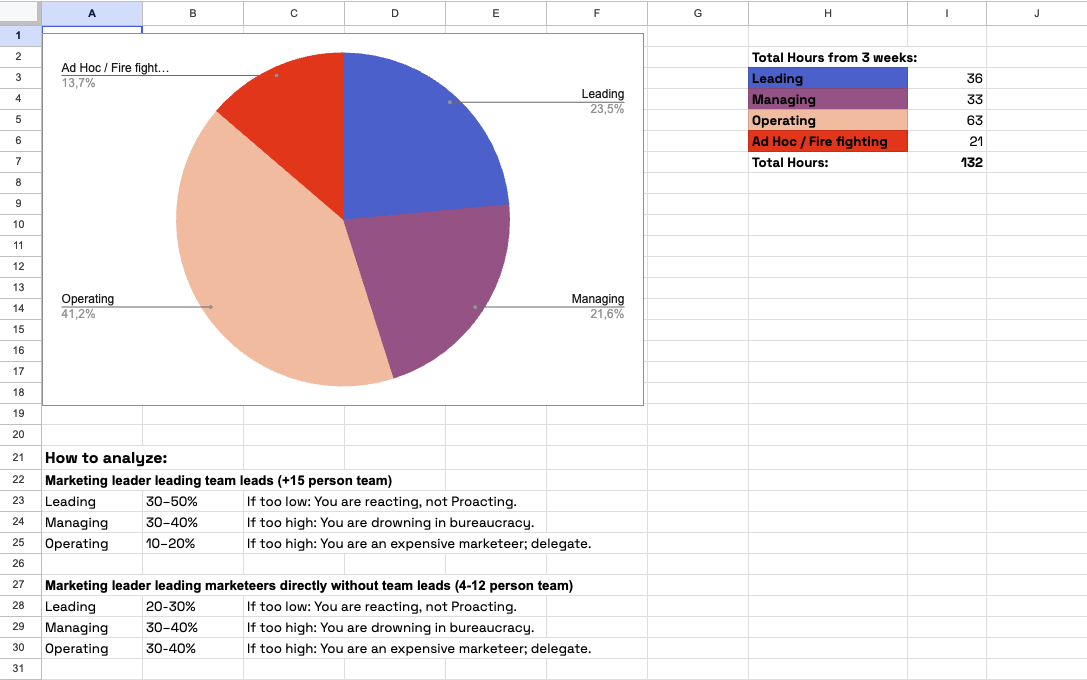
Get the tool: We want to make this as easy as possible for you. You can access the time tracking template here.
Feel free to make a copy for your own use and start reclaiming your strategic focus today.
How to use the template:
1. Track your time in 1-hour increments for a week. Remember to be honest.
2. Put explanations for every hour.
3. End of the week: categorize your work based on the dimensions.
After 2-3 weeks, you have a pretty accurate picture of your current priorities based on the time spent. Now you can compare and make an informed decision if there is something you should change.
Hope you find this useful,-JH-