<img height="1" width="1" style="display:none;" alt="" src="https://dc.ads.linkedin.com/collect/?pid=497913&amp;fmt=gif">
hero-pattern

Value-based reporting: How to build C-level trust

In complex B2B, marketing leaders put significant effort into gathering data and tracking attribution. Still, there’s a gap between marketing data and C-suite trust.

Typically, marketing reports usually only capture about 30% of the total value you create for the company. But why is it so hard to prove value in complex B2B? What are the two specific hurdles that stop you from earning C-level trust?

Learn how to shift your focus from trying to prove the value to building trust by using our IMPACT™ framework.

https://98373.fs1.hubspotusercontent-na1.net/hubfs/98373/IMPACT%20model%20by%20Mavenfirst.png
hero-pattern

From trying to prove the value of marketing to building trust

As a senior marketing leader in a complex B2B environment, you want to design a stronger marketing function and become a trusted business partner within your organization. Getting there requires more than just better data or prettier slides. 

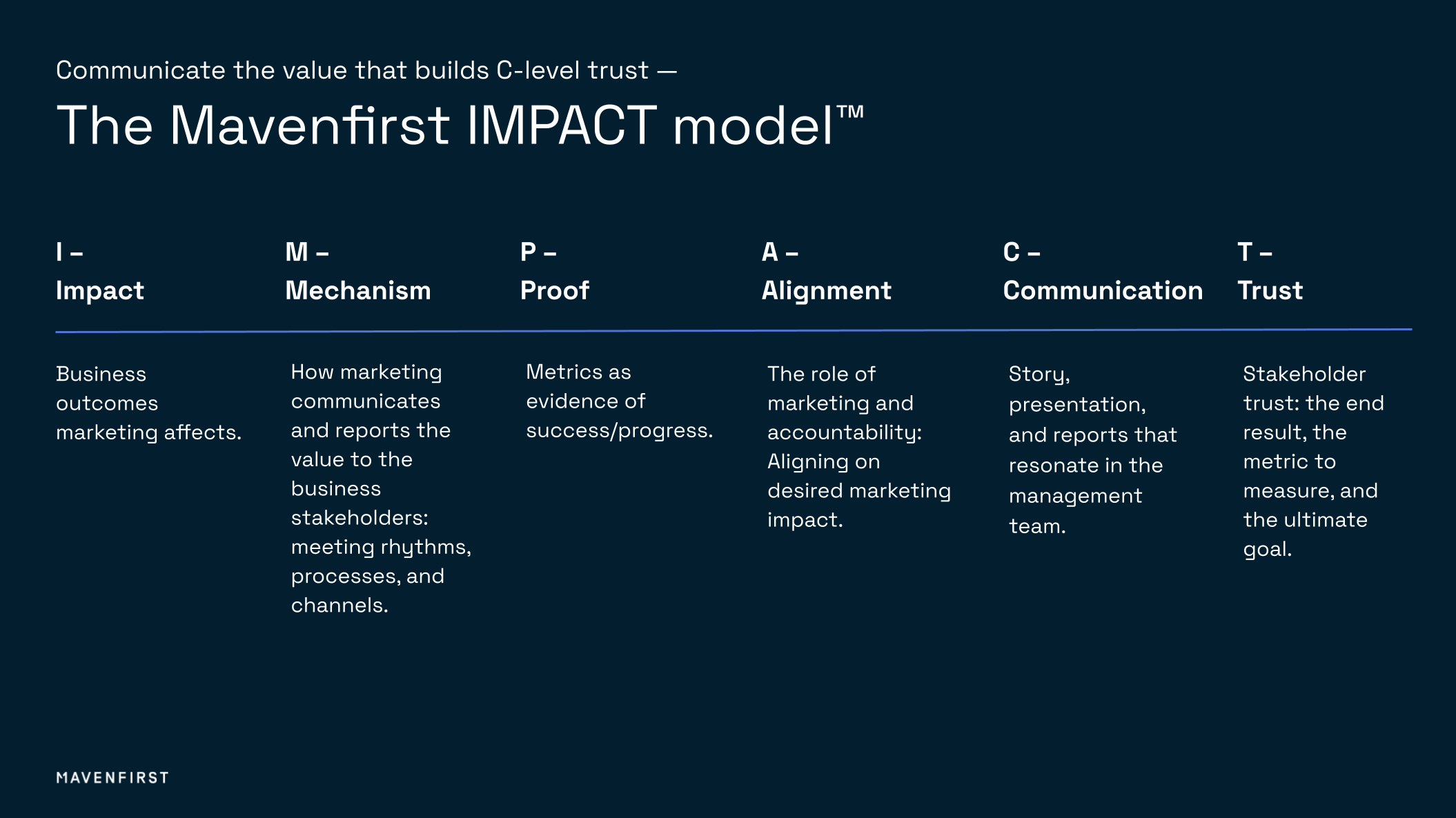
To help you communicate the value that builds trust, we have developed the Mavenfirst IMPACT model™. 

Watch the video series below about value communication. 

Here, you can download the PDF slides.


Why marketing value communication and proving marketing has been an “evergreen” topic in complex B2B for years?


Why is it so hard to prove value in complex B2B, and what are the two specific hurdles that stop you from earning C-level trust?

The Mavenfirst IMPACT model™: I – Impact – What actually improves?


We developed the IMPACT model™ to help you stop trying to prove marketing and start building trust. It’s a practical way to change the conversation from what you are doing to what the business is actually achieving.

The "I" in the IMPACT model is for Impact, defining the business outcomes that marketing affects.

This means answering the hard question: when marketing succeeds, what in our business actually improves? You must be very clear on the processes, results, and metrics marketing is accountable for to achieve that business outcome.

Read also the article about the difficult questions you need to answer if you want marketing to be a business partner. 

M – Mechanism: Why 15 minutes a quarter isn't enough


The "M" in the IMPACT model™ is for Mechanism, which is about how marketing communicates and reports its value to the business. This stage is all about the meeting rhythms and processes you have in place.

The surprising part for many B2B marketing leaders has been that they simply do not have enough time to communicate the marketing value to stakeholders.

In most cases, you must increase your face time with key stakeholders, like sales VPs and the CEO, making sure that time is dedicated to alignment and value communication – not just operational topics.

P – Proof: Metrics as evidence, not the main point


The "P" stands for Proof points, which are the metrics you use as evidence of success or progress.

For B2B marketing leaders, it’s vital to see that the campaign is not the point. We recommend focusing on the focus area or the yearly goal levels, and the finished campaign or tactical data is evidence that you are actually progressing.

A – Alignment: What is marketing accountable for?


The "A" is for Alignment, focusing on the role of marketing and its accountability for what it impacts.

To succeed here, you need to align on three fundamental things: what marketing is accountable for, what in the business improves when marketing succeeds, and how marketing is led or operated.

Bringing visibility to how you want your function to be run, as a business partner or an internal agency, helps build stakeholder trust since many don't know what marketing actually does.

You must gain alignment on the strategic goals, the value levers you want to impact, and your function's long-term picture in terms of structure and budget.

See also the webinar on how to drive change from the support function to a valuable business partner.

C – Communication: Story, presentation, and reports that resonate in the management team


The "C" is for Communication, which is all about the actual reports, the story you tell, and your presentation style to ensure your message resonates in the management team.

A key change is to go heavy on your analysis so your audience never has to guess how you are progressing as a whole. Always focus on the outcomes you have aligned with, not the campaigns and tactics, and ditch all vanity metrics, typically using far less data than before.

T – Trust: How we evaluate an increase in stakeholder trust


The "T" is for Trust, which is the ultimate goal of moving your focus from trying to prove marketing to building trust in your function.

Trust is the stage where you measure your progress. You can track it by using a stakeholder confidence rating, which asks on a scale of one to ten how well they understand marketing's impact on the business based on your current reporting and communication.

Other typical measures of building trust include an increase in face time with your key stakeholders around alignment and value communication, and how well you are able to defend and raise your budget.


Do you want to hear more?

We help senior marketing executives in complex B2B environments design stronger marketing functions and become the trusted business partners.

Do you want to hear what you could do in your situation to build trust among your key stakeholders? 

Let's talk. Contact us by filling out the form below:


Subscribe to our newsletter —


This newsletter is for you: CMOs operating in complex B2B industries who must prove value and manage high-performing teams.

You receive focused insights and original thinking designed to help you build a valuable marketing function toward a more strategic role in your organization.

We don't spam – you'll get emails only when there is a new perspective or a sharp finding (typically 1–2 times per month).


VALUE-BASED REPORTING THAT BUILDS C-LEVEL TRUST —

Watch the full session

You can also watch the entire webinar session to get tips on the changes we recommend to improve communication. 

You'll hear more about our learnings, findings, and most influential changes we've made during client engagements to value communication through the Mavenfirst IMPACT™ model.

highlight-pattern
highlight-pattern highlight-pattern
Follow Jani on LinkedIn

Meet the speaker on LinkedIn

Jani helps senior marketing executives with their challenges and ambitious goals. He has over a decade of experience working with marketing professionals in complex B2B.

Let's connect on LinkedIn.

CASE STUDY
Case From ‘event organizer’ to ‘business partner’ in a global industrial company

CASE STUDY

Moving from event organizer to business driver in a global industrial company

While the business saw marketing as important, its real value was unclear to stakeholders and the team alike. The team operated with defined targets, but these goals often lacked a direct link to broader business outcomes.

For the VP of Marketing, a daily life was filled with back-to-back meetings and constant firefighting.

To change this, the team used The Mavenfirst Marketing Function Business Plan™ to establish a clear direction and a structured framework for their operations.