 Jani Hovila
Marketing yearly planning typically consists of two different questions:
- Where you want to go, as in your yearly goals
- How you get there, as in your plans and campaigns
Yearly planning should focus mostly on where to go, not how to get there.
As a marketing leader, your number one goal in yearly planning is to answer the question: where we want to go. Once you have the destination set, you and your team have much more time to hone and develop the plans for how to get there.
Most yearly planning process sessions are thought of as organizing work and answering the question of what we will do. And unfortunately, from what we have seen, most start drafting yearly plans based on what they did this year, and heavily underinvest in finding, clarifying, and prioritizing where they want to go.
In the end, we see that great yearly planning achieves 3 critical things:
- Alignment for stakeholders and team
- Clear prioritization from the early stages
- Value clarification (In some cases, budget reasoning, e.g., business cases)
1. Clarity for you
We all know the feeling. So much to do. Where to even start?
This is the first goal of any successful, meaningful yearly planning: Getting clarity for you that 'this is what we need to achieve', based on your personal views, business needs, available resources, and expectations.
We recommend 5-15 yearly goals.
2. Alignment
You think that when you succeed in these 5-15 yearly goals, this year is successful. Nothing more, nothing less. This is it.
Your management team thinks the same way. When these 5-15 goals are successful, this is good. Nothing more, nothing less. This is it.
Your team members know. This is what is expected. Achieve these 5-15 goals. Nothing more, nothing less. This is it.
3. Value clarity
You need to get clarity on how these will benefit your business. You need to answer the same old and hard question: When you succeed in these, what and how does the business improve? In our frameworks, this is done on the “Focus Area level”, making sure that the value mechanism is clear. You can emphasize this with the yearly goals as well.
End results: You know, and you have stakeholder consensus, that when these goals are met, this is the value you can expect. For some goals, it might be more short-term (SQLs to order intake), and for others it might be more long-term (your positioning and awareness improving in the target market); either way, the value needs to be clear, and you need consensus on it.
We recommend using our business case framework, which includes a category called “How this impacts your business” that always comes from outside marketing.
Extra: Budget allocation and investment reasoning
If you want to change investment levels or need to defend investments, we recommend building yearly goals as business cases. See more in this article or this video recording.
Write this first draft down and let it guide your yearly planning.
Example of finished yearly goals for a client with 6 team members and Nordic responsibility
This is an example of the level of clarity and accountability you can have when you focus on the critical factors of knowing where to go, rather than focusing too early on what we need to do.
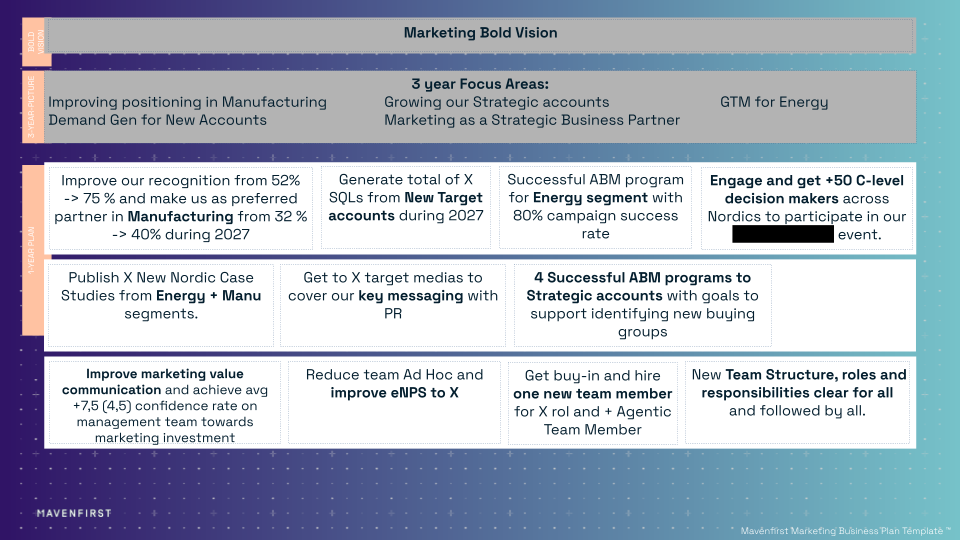
Every yearly goal is directly aligned to one or two focus areas. In each focus area, there is a clear mechanism of marketing value. Example from the “improving positioning in Manufacturing”:
Improving positioning in Manufacturing – 3-year focus area
The goal is to improve the positioning in Manufacturing so that +80% of the target accounts know us and position us correctly. When successful, this will influence our RFI quantity and quality + win rate.
For the yearly goals, we followed a pretty simple process:
First, get a long list from the marketing executive of what good looks like, listing everything you think your team needs to accomplish during a year.
Gather information from your team, stakeholders, and business goals to validate your point of view.
Prioritize that list with the new information so only the most important goals remain. You can prioritize based on multiple factors, but the most important is the marketing influence on the outcome – in what goals your value is important, e.g., you are closer to must-have than nice-to-have.
Formulate each goal to be precise in terms of outcomes. This is typically the hardest part. You need to make a decision about what good looks like. Missing this will result in vague goals and a lack of priorities.
Now you have a list of 5-15 goals in front of you.
First exit criterion for excellent yearly goals: If you could only finish these goals, would you be happy?
Now, get alignment and consensus from your most important stakeholders or management team. Present the goals and try to build alignment.
Second exit criterion for excellent yearly goals: If you could only finish these goals, would the management team (or your stakeholders) be happy? Is this everything, and can you only focus on these?
When you get that done, you are almost there.
Last exit criterion: When presented to your teams as expectations. Can they understand each goal? Can every goal be objectively evaluated? Is there no room for interpretation or guesswork?
If yes, you are ready to start planning how to get there. You and your team know where you want to go. Your stakeholders know where you are going and why. And you have the alignment to start executing.
Have a great week,
-JH-